
Connectivity as a Power Resource: The Competition for New Energy and Trade Corridors in the Middle East
The Middle East is undergoing a profound transformation of its energy and trade infrastructure. From the India–Middle East–Europe Economic Corridor (IMEC) and Iraq’s Development Road to the revival and expansion of existing pipelines, states and companies are investing billions in new transport, logistics and energy links. At first glance, these initiatives may appear to be separate projects. In reality, they reflect a broader geopolitical shift: strategic influence is no longer determined solely by the ownership of natural resources. Increasingly, it also depends on who controls the infrastructure through which energy, goods and data move.
Connectivity is therefore emerging as a central power resource of the twenty-first century. The latest crises in the Persian Gulf did not initiate this trend, but they have accelerated it considerably. The effective closure of the Strait of Hormuz amid the war with Iran has exposed the dependence of the Gulf states and Iraq on a small number of maritime chokepoints. At the same time, alternative land connections through Iraq, the Levant and Türkiye are gaining economic and geopolitical importance.
From IMEC to the Development Road
The idea of creating new regional corridors predates the latest escalation. The US-backed IMEC initiative was designed to connect India with Europe via the Gulf states, Israel and European Mediterranean ports. The war in Gaza and the failure to achieve normalisation between Saudi Arabia and Israel have significantly complicated its political implementation. Nevertheless, IMEC remains an expression of a fundamental strategic objective: to reorganise trade, energy and data connections between Asia, the Gulf and Europe.
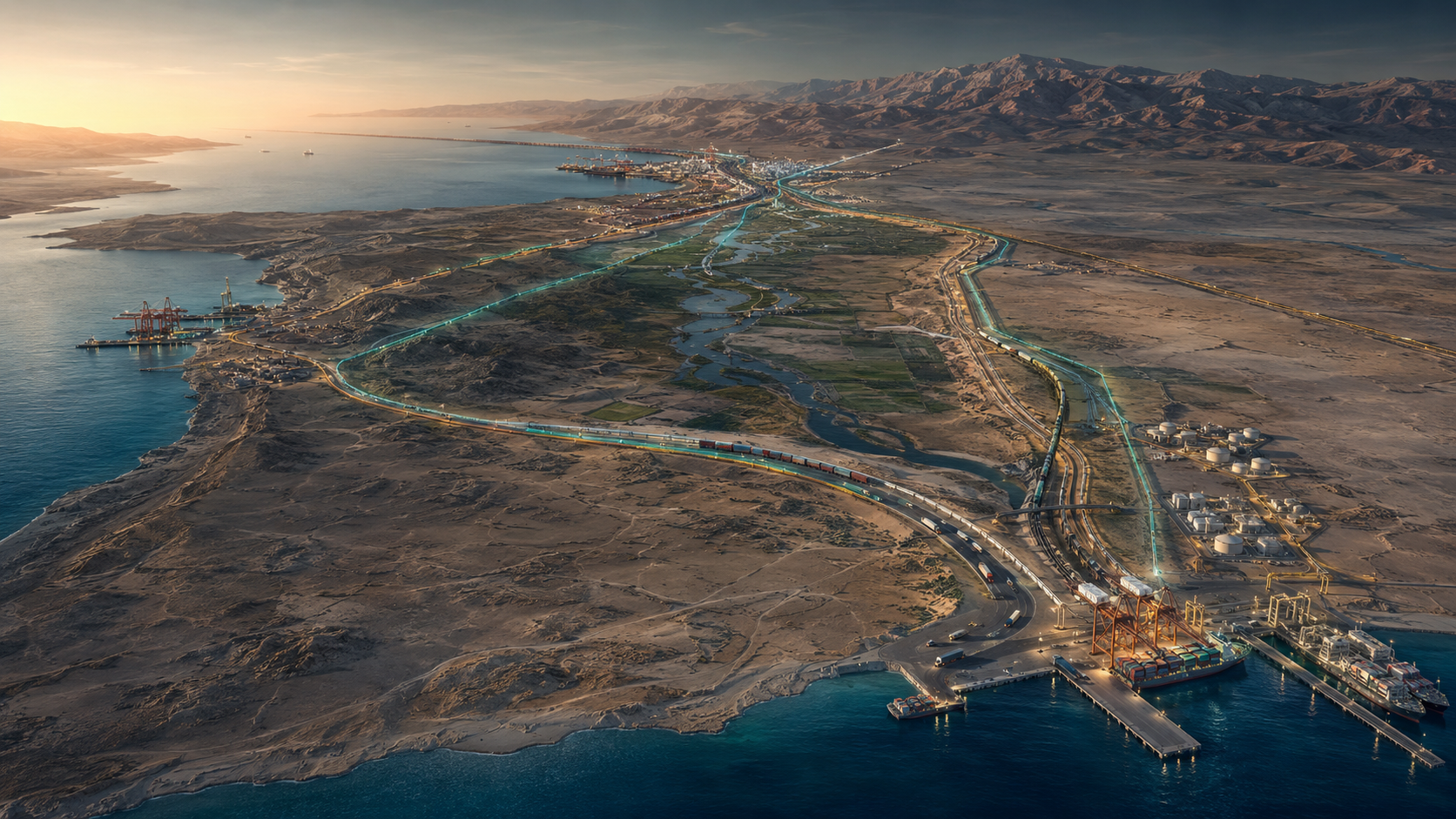
Iraq’s Development Road follows a different geographical approach. Estimated to cost around US$17 billion, the project is intended to connect Grand Faw Port on the Gulf with the Turkish border—and subsequently European markets—through approximately 1,200 kilometres of road and rail infrastructure. In 2024, Iraq, Türkiye, Qatar and the United Arab Emirates established a joint cooperation framework. The Development Road is therefore more than an Iraqi infrastructure project. It brings together Iraq’s diversification interests, Türkiye’s transit ambitions and the Gulf states’ growing logistical and political engagement.
Initial transport operations demonstrate that broader overland connectivity is not merely hypothetical. The international TIR transit system has been operational in Iraq since April 2025 and is now mandatory for road transit through the country. Pilot shipments have connected Türkiye with Kuwait and Jordan via Iraqi territory. TIR operations through Syria towards GCC markets have also resumed. In July 2026, a temperature-controlled road shipment travelled from Ireland to the United Arab Emirates via Türkiye, Syria, Jordan and Saudi Arabia. Such connections will not replace maritime shipping or the planned expansion of the Development Road. They do, however, demonstrate that new logistics axes between Europe, the Levant and the Gulf are already taking shape.
Iraq at the Centre of a New Corridor Strategy
The strategic value of alternative routes is particularly evident in Iraq. The country is among the world’s largest oil producers and has recently derived around 90 percent of government revenue from the oil sector. Most of its exports are handled through the southern terminals near Basra and therefore pass through the Strait of Hormuz. When traffic through the strait collapsed in 2026, Iraqi oil exports via Hormuz temporarily fell from approximately 93 million barrels per month to only around ten million. The crisis demonstrated how vulnerable a resource-rich country can become when its export infrastructure remains concentrated on a single dominant maritime route.
Baghdad is therefore not pursuing a single-corridor strategy. The Iraqi government is working simultaneously on several northern and western export and trade axes. These include the connection to Ceyhan, a potential Mediterranean route through Syria, an option via Jordan and the Development Road. The objective is to secure multiple points of access to international markets and thereby reduce both economic risks and dependence on individual neighbouring states.
The Emerging Türkiye–Iraq Energy Arrangement
The Kirkuk–Ceyhan pipeline lies at the heart of the northern route. The two-line system connects the northern Iraqi oil fields with the Turkish Mediterranean port of Ceyhan and has a nominal total capacity of almost 1.5 million barrels per day. In practice, however, utilisation has remained significantly lower. Following an international arbitration dispute, exports through the pipeline were suspended for approximately two and a half years before flows resumed in late 2025.
The previous intergovernmental pipeline agreement expired on 27 July 2026. Ankara and Baghdad are now negotiating a broader framework that could extend beyond crude oil transit to include natural gas, electricity and new pipelines reaching into southern Iraq. A comprehensive new intergovernmental agreement had not yet been concluded during the talks on 28 July. Both sides nevertheless stated that they intended to sign it as soon as possible.
At the same time, a concrete and strategically important agreement was announced: the state-owned Turkish Petroleum Corporation (TPAO) will acquire a 15 percent stake in BP Energy Company of Kirkuk Limited, the BP-led company responsible for developing major fields around Kirkuk. Türkiye is thus moving beyond its role as a transit actor and becoming more directly involved in Iraqi production. President Recep Tayyip Erdoğan described the agreement as a historic step in the bilateral energy partnership and raised the prospect of long-term oil flows of up to one million barrels per day.
This combination of production participation, pipeline access and a possible southward extension significantly strengthens Türkiye’s position. For Iraq, it simultaneously provides a much-needed alternative to the southern export terminals. The relationship nevertheless remains asymmetrical: the more important Ceyhan becomes for Iraqi exports, the greater Ankara’s potential political and economic leverage. Baghdad’s simultaneous pursuit of additional routes is therefore not a rejection of Türkiye, but a strategy to prevent the emergence of new one-sided dependencies.
The Levant Returns to the Corridor Map
This reordering is not confined to the Iraq–Türkiye axis. The Levant is also becoming increasingly integrated into the emerging corridor architecture. Functioning road transit between Türkiye, Syria, Iraq and the GCC states gives Damascus a potential role as a regional transit country for the first time in years. Jordan, meanwhile, can be linked to new trade flows between Türkiye and the Gulf through both Iraq and Syria.
The proposed revival of the Kirkuk–Baniyas connection carries even greater geopolitical significance. In July 2026, Iraqi and Syrian actors signed agreements to examine the reconstruction of the pipeline, which has been out of operation since 2003. A consortium comprising Chevron, Qatar’s UCC Holding and TI Capital is expected to prepare technical and financial studies and an implementation framework. A potential initial transport capacity of up to two million barrels per day has been cited. This figure, however, is a project objective rather than an already available capacity.
A restored connection to Baniyas would give Iraq direct access to the Syrian Mediterranean coast while bypassing Türkiye as a transit state. It could also connect Syria more closely with Iraq and the Gulf states economically. Its implementation nevertheless remains subject to considerable political, legal, financial and security uncertainty. The condition of the existing infrastructure, sanctions, ownership questions and the stability of the transit areas would all have to be resolved.
The route through Syria is therefore not simply a competitor to Ceyhan. Rather, both projects illustrate Baghdad’s strategy of developing several Mediterranean outlets in parallel. Iraqi planning also includes a strategic pipeline from Basra through Haditha, with possible branches towards Baniyas, Ceyhan and the Jordanian port of Aqaba. If even part of these plans is implemented, Iraq could evolve from an exporter almost entirely dependent on Hormuz into a regional hub between the Gulf and the Mediterranean.
Türkiye as the Central Hub
Türkiye has long sought to establish itself as an energy and logistics hub between Europe, the Middle East, the Caucasus and Central Asia. The Baku–Tbilisi–Ceyhan pipeline, TANAP, TurkStream, several LNG terminals and the expansion of the Middle Corridor already constitute important components of this strategy.
The Development Road and the deepening partnership in Kirkuk extend this role southwards. Ankara could in future do more than enable the transit of Iraqi oil: it could participate in its production, consolidate new trade flows from the Gulf and control access to European markets. Connectivity would thus generate not only transit and logistics revenue but also political leverage over producers, investors and consumers.
Türkiye is not without alternatives, however. The routes through Syria and Jordan demonstrate that Iraq and the Gulf states intend to keep several options open. What is emerging is therefore not a unified network under Turkish leadership, but competition between different corridors, investors and transit models. This competition is likely to shape regional infrastructure policy in the years ahead.
The Strategic Opportunity for the Gulf States
For the GCC states, the new corridors offer far more than additional transport routes. Investments in ports, railways, pipelines, power grids, free zones and digital infrastructure allow them to convert financial capital into lasting political influence. The United Arab Emirates contributes its expertise in port and logistics management, while Qatar combines its involvement with close relations with Türkiye and, through UCC Holding, participation in the proposed Baniyas route. Saudi Arabia, Kuwait and Jordan could provide further cross-border connections.
The Gulf states also gain an opportunity to anchor Iraq more firmly within its Arab neighbourhood. Iraq remains closely intertwined with Iran through energy imports, trade, religious networks and Iran-aligned political and armed actors. Deeper integration into GCC-financed energy, transport and investment networks could gradually reduce Baghdad’s dependence on Tehran.
The strategically sustainable objective is not direct confrontation or the complete displacement of Iran. A more promising approach would be to strengthen Iraq’s strategic autonomy. The more access Iraq has to capital, energy, infrastructure and export markets, the less any single neighbouring country can use economic dependence as political leverage. For the Gulf states, this would amount to competition through integration—a potentially more effective instrument than a policy based solely on containment.
Iran will nevertheless monitor these developments closely. New corridors that bypass Iranian territory and expand GCC and Turkish influence in Iraq directly affect Tehran’s economic and geopolitical interests. Iran-aligned actors may therefore seek to influence route selection, contracts or security arrangements. Protecting the corridors will consequently depend not only on technology and capital, but also on stable Iraqi institutions, transparent procurement and the inclusion of local communities.
Why Europe Should Pay Attention
For Europe, additional links between the Gulf and the Mediterranean could improve the resilience of energy supplies and trade chains. At the same time, they would create new dependencies on transit states and politically fragile regions. The decisive question is therefore not merely whether new corridors will emerge, but under what rules they will operate and who will control access, prices and security.
A more detailed European strategy—including the potential role of Cyprus and the relationship between the Development Road, IMEC and European transport networks—requires a separate analysis. What is already clear is that the emerging infrastructure order in the Middle East will shape Europe’s economic and strategic room for manoeuvre.
Conclusion
The competition for new energy and trade corridors marks a fundamental shift in the regional order. The Development Road, the deepening Türkiye–Iraq energy partnership, the possible revival of the Kirkuk–Baniyas pipeline and the new road connections through the Levant are not isolated projects. Together, they reflect the efforts of regional actors to expand their economic and foreign-policy options through alternative links between the Gulf, the Mediterranean and Europe.
Control over oil and gas reserves is no longer the only source of influence. Increasingly, control over infrastructure, standards and transit hubs determines who can exercise political and economic power. Türkiye is positioning itself as a central hub, Iraq is attempting to balance new dependencies through multiple routes, and the Gulf states have an opportunity to expand their influence in Iraq and the Levant through investment and integration.
Whether these initiatives develop into a resilient regional infrastructure architecture will depend on more than billions of dollars in investment. Security, transparent governance, customs integration and political cooperation will determine whether connectivity becomes a driver of regional stabilisation—or another arena of geopolitical competition.