
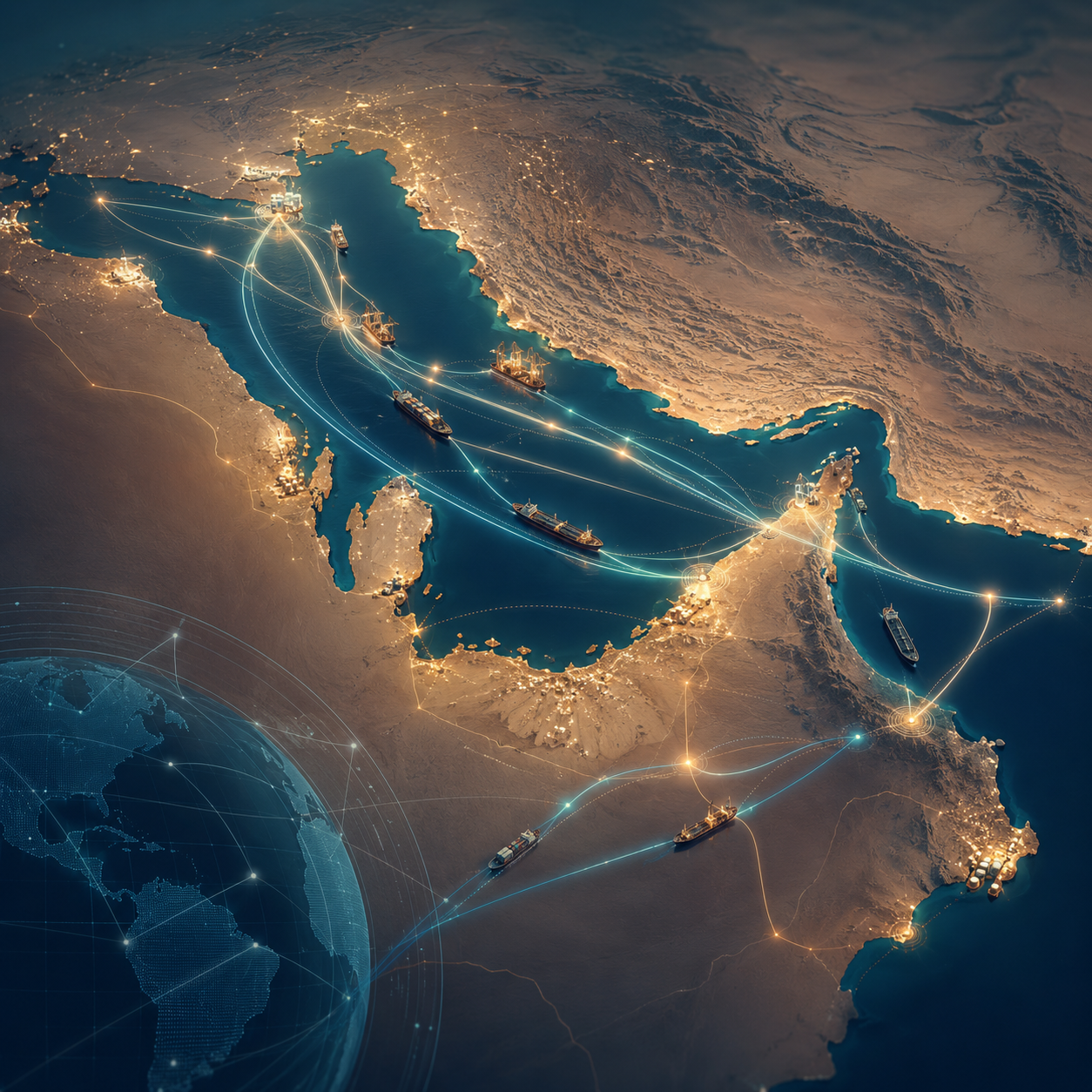
Beyond Oil: Why the Strait of Hormuz Matters for Global Business, Energy Security and Supply Chains
The Strait of Hormuz has once again become the focal point of a rapidly escalating regional crisis. Yet the economic implications now extend far beyond the question of how many barrels of oil leave the Persian Gulf each day.
Recent developments are also affecting liquefied natural gas (LNG) exports from Qatar and the United Arab Emirates, international shipping routes, transport insurance, critical infrastructure and the planning of international investment projects. As a result, the Strait of Hormuz is no longer merely a geographic chokepoint, it has evolved into a strategic business risk with global implications.
For companies, the central question is therefore not only how long the current escalation may last. Equally important is whether supply chains, contractual arrangements, operational planning and investment strategies are prepared for a prolonged period of geopolitical uncertainty.
Shipping Activity Is Already Under Pressure
Current maritime data illustrates how rapidly the deteriorating security environment is affecting commercial traffic through the Strait. According to Reuters, only four commercial vessels transited the Strait of Hormuz on Sunday, 19 July, compared with eight vessels on the previous day.
Particularly striking has been the development in the LNG sector. Since Thursday, no LNG tanker has been visibly recorded transiting the Strait. While vessel tracking data has its limitations: ships may deactivate transponders and not every voyage can be fully monitored: the available information nevertheless points to a significant decline in visible LNG movements. Importantly, LNG production and loading operations in Qatar and the United Arab Emirates have continued without major disruption. Consequently, growing volumes of already-produced LNG are now being stored aboard tankers waiting inside the Gulf.
According to S&P Global, by mid-July seven fully loaded Qatari LNG carriers, transporting approximately 570,000 tonnes of LNG, remained in the region. Total LNG tanker capacity inside the Gulf approached 1.9 million tonnes, equivalent to roughly eight days of normal export volumes from Qatar and the UAE before the current conflict.
The immediate challenge therefore lies not in energy production itself. Instead, the emerging bottleneck is the ability to transport existing production safely to global markets.
Energy Markets Respond to Renewed Escalation
Financial markets have already begun pricing in these growing risks. On Monday morning, Brent crude oil rose above USD 90 per barrel, reaching its highest level since 11 June after gaining almost 16 percent during the previous week.
The Strait of Hormuz remains one of the world's most strategically significant maritime corridors, with approximately one-fifth of global oil trade passing through the waterway under normal circumstances. Even without a complete disruption of shipping, reduced traffic capacity, higher insurance premiums and longer transit times can substantially affect energy prices and market availability.
For European businesses, this translates into several simultaneous challenges:
- higher oil and natural gas prices increase production and transportation costs;
- delays in LNG deliveries complicate energy procurement and planning;
- shipping companies and insurers continuously reassess operational routes;
- uncertainty grows regarding which ports and logistics corridors will remain reliable in the weeks ahead.
Geopolitical escalation is therefore no longer merely an issue for foreign policy specialists. It has become a direct operational variable for businesses, investors and international supply chains.
Saudi Arabia Expands Alternative Export Routes
At the same time, the current crisis demonstrates that the Gulf states have not remained passive in the face of the Strait of Hormuz's structural vulnerability. During the first half of July, crude oil and condensate exports from Saudi Arabia, the United Arab Emirates, Iraq, Kuwait and Iran increased by approximately 16 percent compared with average daily export levels in June. Nevertheless, overall exports still remained around 32 percent below pre-war levels recorded in February. Saudi Arabia provides perhaps the clearest example of long-term strategic preparation.
Approximately 75 percent of Saudi crude oil and condensate exports during July were shipped via the Red Sea port of Yanbu. Through its East–West Pipeline, the Kingdom is able to transport a substantial share of its energy exports from the Persian Gulf directly to the Red Sea, bypassing the Strait of Hormuz altogether. This infrastructure represents far more than an emergency contingency plan. It constitutes a long-term strategic advantage.
Pipelines, storage facilities, alternative export terminals and interconnected logistics networks have become essential components of national resilience. Countries capable of offering multiple export corridors strengthen not only their own energy security, but also their attractiveness for international investors, multinational corporations and long-term infrastructure projects.
Nevertheless, the Red Sea corridor is not without risks. Reuters has reported, citing regional sources, that Iran instructed Yemen's Houthi movement to prepare for potential disruptions to Red Sea shipping should Iranian energy infrastructure come under attack.
Should this scenario materialise, two of the Middle East's most important maritime corridors could come under simultaneous pressure: the Strait of Hormuz in the east and the Bab al-Mandab–Red Sea corridor in the west.
From Country Risk to Corridor Risk
Traditionally, companies assess international markets through indicators such as political stability, regulatory frameworks, currency exposure and legal certainty. While these factors remain essential, they are no longer sufficient when evaluating investment opportunities in the Gulf.
A production facility may be located in a politically stable country while still depending on a single port, pipeline, airport or maritime chokepoint. If that corridor is disrupted, even the most stable business environment can experience severe operational consequences.
Businesses should therefore expand their risk assessments beyond individual countries and evaluate entire supply and infrastructure corridors. Key questions include:
- Which ports handle imports and exports?
- What viable alternative routes exist?
- Which pipelines, power grids or water infrastructure are critical to operations?
- How do insurance policies respond to military escalation?
- How long can local inventories sustain production?
- Which contractual partners bear additional transportation and security costs?
Recent attacks on infrastructure across several countries in the region demonstrate that civilian logistics and critical infrastructure have themselves become strategic assets requiring continuous risk assessment.
The European and Regional Dimension
On 19 July, the Gulf Cooperation Council (GCC) and the European Union reaffirmed their commitment to the principle of free navigation through the Strait of Hormuz.
In a joint statement, both sides rejected unilateral transit restrictions, passage fees and other limitations on international maritime traffic while pledging continued cooperation to safeguard regional shipping.
For Europe, this position extends well beyond traditional security policy. European industry remains heavily dependent on stable energy imports and reliable trade routes connecting Europe, the Gulf and Asia.
The current crisis also highlights a broader strategic reality: future EU–GCC cooperation must increasingly integrate maritime security, critical infrastructure protection and supply-chain resilience alongside energy and investment partnerships.
Future cooperation can therefore no longer focus solely on energy imports or bilateral investment agreements. It must also encompass the protection of ports, digital infrastructure, energy facilities, water systems and strategic transportation corridors.
A Prolonged Crisis Has Become More Likely
Beyond developments at sea, recent military deployments suggest that businesses should prepare for more than a short-term disruption. According to reporting cited by The New York Times and the Spanish news agency EFE, the United States has redeployed additional F-16 fighter aircraft from Germany and F-35 aircraft from the United Kingdom to the region, alongside additional aerial refuelling capabilities.
While these deployments do not predict a specific military outcome, they indicate preparations for a potentially prolonged or expanded operational environment. For businesses, this does not mean attempting to forecast military developments. It means avoiding strategic planning based solely on expectations of a rapid return to normality.
Instead, companies should prepare multiple operational scenarios: from several weeks of disruption to a longer period of sustained pressure on critical energy and transportation routes.
Five Strategic Priorities for Businesses
1. Assess Supply Chains by Corridor, Not Only by Country
The geographical location of suppliers is only part of the equation. Companies should evaluate the complete logistics chain: from production sites to final destination markets.
2. Operationalise Alternative Routes Before a Crisis
Identifying an alternative port on a presentation slide is not a contingency plan.
Transport capacity, logistics providers, regulatory approvals, insurance coverage and additional costs should already be in place before disruption occurs.
3. Review Contracts Through a Geopolitical Lens
Force majeure clauses, delivery schedules, price adjustment mechanisms and the allocation of additional transportation costs have become increasingly important. Companies need clarity regarding financial responsibilities if shipments are delayed or rerouted.
4. Strengthen Local Partnerships
Regional partners often possess superior knowledge of alternative logistics networks, regulatory procedures and governmental decision-making processes. Strong local networks therefore become an integral component of corporate resilience.
5. Translate Geopolitical Intelligence into Operational Decisions
Monitoring geopolitical developments alone is no longer sufficient. Companies require clearly defined decision thresholds:
- At what point should shipments be rerouted?
- When should business travel be restricted?
- Which price level or delivery delay triggers a reassessment of project economics?
This is where geopolitical analysis evolves from information into strategic decision-making.
Conclusion: Resilience Will Define Competitiveness
The current escalation underscores the vulnerability of the Strait of Hormuz. At the same time, it demonstrates how extensively the Gulf states have already invested in alternative infrastructure, diversified export routes and more resilient logistics networks. The region's economic transformation is therefore unlikely to come to a halt. Instead, it is entering a new phase.
In the years ahead, competitiveness will no longer be determined solely by which countries succeed in developing new industries, attracting investment or advancing technological innovation. Increasingly, it will depend on the ability of governments and businesses to integrate economic transformation with infrastructure resilience and geopolitical risk management.
For European companies, the Gulf remains a key partner for investment, energy cooperation and long-term growth.
However, successful engagement requires moving beyond two common misconceptions: viewing the region either exclusively as a market of opportunity or solely through the lens of geopolitical instability. Both perspectives are incomplete.
A more strategic approach is needed: one that combines political developments, economic transformation and operational dependencies into a single integrated framework for decision-making.
Companies that embed geopolitical analysis into corporate strategy today will be better positioned to navigate future disruptions, protect supply chains and identify new opportunities in an increasingly complex international environment.
Future Focus MENA helps businesses translate geopolitical developments into actionable strategic decisions. Through executive briefings, market intelligence, geopolitical risk assessments and long-term strategic advisory, we support organizations operating across the Middle East and North Africa in navigating an increasingly complex geopolitical landscape.